Gail Nash's Blog

@kwgailView Housing Trends
(713) 530-0150

Client Experience Rating    4.91/5.0       Based on 28 Surveys out of 66 Transactions   View Rating Detail
KELLER WILLIAMS REALTY METROPOLITAN
        EMAIL ME        550 Post Oak Blvd Ste 350, Houston, TX 77027     Phone: (713) 621-8001     Fax: (713) 661-6675
I am a Realtor in Houston, Texas, who used to have a staging business before getting a real estate license. I am passionate about "green" ideas and practices, love gardening, and I enjoy volunteering in this great City of Houston.
AUG
8
From an earlier posting, you would have read that our vegetable garden this year was all in pots.  I could easily use only organic soils, compost, fertilizer and bug removal.  Early on, I observed the leaves of my tomato plants being so large, so green and free from insects.  Out of 14 plants, I think I saw about 5 very small worms, that I just picked off the plants.  My fertilizers were epsom salts, bone meal and a little bit of fish emulsion.  We have never had such beautiful plants loaded with blooms and fruit!  (Tomatoes are a type of fruit!)
In today's Houston Chronicle (8/8/10), Urban Harvest has confirmed my observations and expanded the subject to encourage me to include plants in the garden that encourage bugs that eat other pests and discourage disease.  Sounds like a great plan to me!
I made a mistake and planted Cilantro this past spring--won't do that again.  Urban Harvest suggests planting Cilantro and when it flowers, it will attract adult-beneficial insects.  Other options are dill, mint, and Italian flat-leafed parsley.  (My parsley is going to seed now.  I'll need to start over soon, because it does so well in the winter months.)  These plants are called "pest magnets", because when blooming, they attract tiny stingless wasps that lay eggs in the pests, killing them. 
Check out the very informative website for Urban Harvest at www.urbanharvest.org.
How do you control pests in your garden and home?
JUL
11
When putting your home on the market, it's critical to attract buyers, so that they want to come see the inside of your home.  Having a "car stopping" front door is a big step toward making that happen.  

Johnnie Chuoke, the Happy Handyman, owns a hardware store in San Antonio, and wrote an article in a local paper last week that tells you how to transform your front door yourself.  "People will just drive off if the front of the home doen't just grab them.  And the front door can be the most exciting way to make an impression of new buyers." 

First you need to prepare the door by removing the old paint or varnish.  He suggests Soy Gel, a safe remover that is 100% biodegradable.  It's made of 100% soy beans, grown in America.  Apply it to a small area of the door and see how long it takes to remove the paint; then you know how long it will take to do the whole door.  When it's ready to be removed, just use a plastic scraper to scoop off the paint or varnish.  After you have removed the gel, take off the residue with water and a rag or scrub pad.  Let the surface dry.  Now, you think he's going to tell you to sand the door, but with this product, it's not necessary!

The paint he recommends is a Coronado Paint product called Rust Scat Enamel, and it comes in semi-gloss or a high gloss.  It's an oil base paint that is a great primer in itself, so you are priming in your final color and then apply a finish coat.  One quart should do it!  You should use a synthetic bristle brush for the painting. 

He says this kind of paint is good for metal doors and even concrete floors.  His products are available at www.acmelumber.com.

Get that front door ready for the market, and don't forget to make sure the surrounding area looks great, too.  You know that while agents are opening the door, the buyers are standing on the porch looking at every detail of the entry! 

Do you have a picture of your unique front door that you would like to share?
JUL
6
While I was in Seattle a couple of weeks ago, I went to Theo Chocolate for a tour.  This is a company that is commited to being green, organic and fair trade certified.  And with the exception of the confections, their chocolate is also kosher.  Why not?  This is the only chocolate factory of this kind in the U.S.! 
Most people realize that organic implies the trees are not treated with pesticides and chemical fertilizers, but do you know what is involved in a Fair Trade Certification?  One thing is a commitment to excellence as well as to the families who grow and harvest the cacao.  The children get adequate nutrition and acess to healthcare and education, and therefore have a chance for great opportunities in life.  The farmers have an opportunity to improve their technology and growing techniques in order to grow their business.
Theo also runs the business in a green way.  The factory was installed in an existing building.  Their roaster was made in 1930 and still works perfectly.  Using green energy sources to power the factory, using sustainable packaging and printing methods, and educating those on their tours regarding social and environmental accountability presents a great example to other businesses and their customers for supporting green living!
And by the way, the chocolate taste is incredible! 
Check out their website and product line at www.theochocolate.com to learn more about this great company and find out where you can buy and experience the chocolate.
Do you know about a green business that is so thorough in its commitment? 
JUN
30
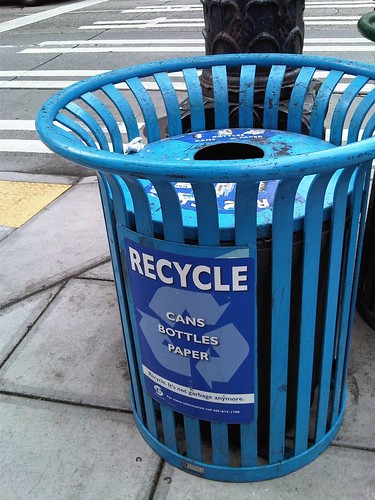
While visiting my daughter last week in Seattle, I was so impressed at how much the city and businesses are doing to embrace the idea of taking care of the environment.  From the Link light rail ride from the airport to my B & B downtown ($2.50 or $1.25 for senior), to my wait in the airport on my way out of town, I observed so many examples that seem easy to implement.  At the airport in each seating area are three bins, one for mixed paper, one for plastic and one for trash. 
The recycle bins pictured above are on every block of the streets downtown and other areas of the city.  Solar trash compactors are also found downtown.  I watched the recycle containers being emptied by Public Works at night. 
Apartment dwellers have opportunities, too.  Multiple bins are in place for metal/aluminum, paper/cardboard, plastic, and glass.  You can take your recycling out any hour of any day of the week, and it's gone!  How convenient is that?!
Buses have run on electric wires for years, but buses that are not electric, I observed most, if not all,  to be hybrid. 
The guys at the Pike Street Fish Market put their merchandise in biodegradable bags, written in large letters on the bag.  Those guys are proud to be making a difference!
Molly's Ice Cream Shop has paper cups and plastic spoons that are compostable.  There is a sign stating so right above the receptacle labeled "compost", not "trash". 
My next posting will be about a company I toured that is so green, it's USDA Organic, Fair Trade Certified, and working on kosher!
Meanwhile, remember "Recycle or Compost; it's not garbage or trash anymore!"
APR
13
In the past, I've dealt with various issues with my garden.  There have been worms of various colors and sizes, beetles, fungus, and on and on.  This spring, the garden all went in pots.  I've had my herbs in pots for years, in order to confine them to a certain space.  Last fall we tried a few tomato plants in pots and they did very well, so we thought it would be great to expand the success. 
Some herbs like basil and sage, had to be replanted, but I added cilantro and salad burnet.  Cilantro is an ingredient in a new favorite recipe and I hate buying such a huge amount at the store, and then not using half of it.  Salad burnet was introduced to me by my cousin recently.  It's a more dainty plant than parsley, and tastes like cucumber; it's wonderful! 
My thyme, rosemary, parsley, sweet marjoram and oregano survived the hard winter beautifully, and the mint has come back more beautiful than ever. 
Tomatoes are in pots with green and red onions, bell pepper plants and collard greens.  It's like furnishing a NYC apartment trying to get everything you need moved in the space!  Kentucky Wonder pole beans have a tomato cage in the pot, so they will have a place to climb soon.  Watermelon radishes are new to me; they grow to 4" in diameter and are white on the outside and red on the inside!  I'll post pictures of those later.
All the soil is organic, various types of compost, and since everything is in pots and requires more fertilizer, I am giving everything a dose of something every Saturday; epsom salts (for magnesium and sulfur), bone meal ( for phosphorus), or fish emulsion (for nitrogen). 
I'm putting my experiment out there for all to see the good and the bad, and we'll all learn, hopefully! 
Let me know how your garden grows!
MAR
29
James Dulley, Energy and Home Improvement Expert writes:

Click here to see a descriptive illustration showing several designs of instantaneous water heaters.

Q: We run out of hot water many mornings. I know a tankless water heater costs more to install than a standard one, but will a small tankless model really provide enough hot water for endless showers? - Lynn E.

A: A gas or electric tankless water heater can not only provide enough hot water for 20 consecutive showers in the morning, but it does this more efficiently than a standard tank-type water heater. An average-size family should notice $50 to $100 annual savings on its utility bills.

Some tankless water heaters can cost twice as much as a standard water heater, but the savings will pay back the higher cost. Since there is no tank to rust out, tankless water heaters have a very long life. They can also be repaired when a part wears out as opposed to a standard one which must be replaced every 10 or 15 years when the tank rusts out and leaks.

A lower-cost option is to install just a tiny point-of-use tankless water heater in the water pipe at the main shower or bathroom faucet. The electric ones are easiest to install in a bathroom. Some models operate on standard 110 volts, but the more powerful models use 220 volts. Some have digital controls that monitor the temperature up to 120 times per second.

Unlike older tankless water heaters, new ones with solid-state controls maintain a steady hot water temperature. This is accomplished by using variable gas burners or multiple-step electric heating elements which vary the heat output depending on how much hot water is being used at the time.

It is important to understand how a tankless water heater works to determine if one is your best choice. When someone opens a hot water faucet, the tankless water heater senses this and starts the gas burner or the electric heating elements. This heats the water as it flows through.

Gas models provide the greatest amount of hot water, up to six gallons per minute (gpm). If you try to simultaneously take three showers, run the clothes washer and dishwasher, you may exceed the instantaneous hot water output of the tankless water heater so the water temperature may drop.

The majority of the utility bills savings with a tankless model results from the elimination of the big tank of hot water and its losses. During summer, the heat loss through a standard water heater tank wall is a double cost because it makes your air conditioner run harder to cool your house.

Tankless water heaters (even powerful whole-house models) take up little space (about two cubic feet) and are often mounted on a wall or in a closet. Many of the gas models are direct-vent designs which do not require a chimney. They are ideal for switching from electric to gas (propane) heat.

Instant Download Update Bulletin No. 678 - buyer's guide of 16 manufacturers (60 models) of gas and electric instantaneous water heaters showing model names/numbers, voltage required, hot water flow rates at various temperatures for comparison, features including controls, sizes, sizing flow rate chart and illustrations of unique models.

If you have a tankless water heater, please feel free to comment on how well you like it, and why you bought it.

MAR
22
Spring Cleaning the Healthy, Green Way!

This is great information that gives you permission to throw out the old cleaning products (take them to a toxic waste collection point) and begin to use products already in your pantry!  I've been using 1/2 vinegar/water solution and newspapers to clean windows for the last couple of years and it is just amazing how well it works!
Here are more hints, courtesy of Belinda Large, MDI Mortgage Bankers:

Safe Spring Cleaning for Your Home and Family

Many parts of the country are already warming up to spring...and that means spring cleaning. But have you ever considered what you're using to clean your home...and if it's really safe for your family? The problem with cleaning products is that there is very little regulation and virtually no labeling requirements.

"A lot of cleaning products contain toxic ingredients that aren't properly regulated, disclosed, or in some cases even tested," said Sara Mohs, co-founder of simplyneutral™, a company that promotes sustainable living through non-toxic cleaners.

In fact, most household cleaners are produced using a petroleum-based formula. That's right, petroleum! In addition, they typically include chemicals, fragrances, and dyes that can be irritating to your eyes, skin, and respiratory tract.

In light of last week's Poison Prevention Week, here's a list of natural alternatives that work great and are probably already in your pantry:

Baking soda - We all know that baking soda absorbs odors, especially in refrigerators, but did you know it's also a simple and effective cleaner? Just mix baking soda with warm water for an inexpensive cleaner comparable to commercial "abrasive" cleaners.

Vinegar - White vinegar is actually a deodorizer and a disinfectant...making it a great all-purpose cleaner. Avoid using vinegar solutions on marble or grout, but it's perfect for all of the other surfaces in the kitchen and bathroom.

Lemon juice - Use lemon juice on hard-water stains, soap scum, even rust stains in the shower, tub, and toilet. Mix lemon juice with salt to remove stubborn stains from coffee pots. Or you can mix lemon juice with baking soda for a softer, paste-like cleaning solution. Add a little to olive oil for an effective wood polish. Blend it with water to make a potent air freshener.

Cornstarch - Cornstarch makes an effective glass and surface cleaner. Plus, you can combine 2 tbsp of cornstarch with 3/4 cup of baking soda for an inexpensive carpet freshener.

Borax - Also known as sodium borate, borax is best known as a hard-water laundry soap, but it also cleans wallpaper, painted walls, and other painted surfaces.

In addition to these natural ingredients, there are also a number of non-toxic cleaners that can be bought in stores. But make sure you consider a couple of points before making your purchase.

First, read the label carefully. "Although a cleaner may contain natural ingredients, it may also include dyes, fragrances, or synthetic preservatives," Mohs said. "For example, if the label says fragrances are added, it may contain up to 150 synthetic chemicals."

Second, you may want to take a quick look at the company itself to see if it is serious about producing natural cleaners that are safe for your family, your home, and the environment.

Let me know what works for you!


MAR
3
Green Bathroom Remodeling


If you want to make sure your bathroom remodeling project is as green as possible, here’s how to save energy, conserve resources, and protect your budget.

You care about the environment. You also happen to have a bathroom badly in need of remodeling. How do you get the job done with minimal impact on both our fragile planet and your precious budget? Thankfully, the growth of the green building movement has given rise to many eco-responsible products and resources that allow you to create the water-conserving, healthy, energy-wise bath you’ve always wanted—all without busting your bottom line. Here’s what you need to know.

It’s all about the water
Thinking about greening your bathroom means considering how you use water in terms of consumption and energy. According to the American Water Works Association, your humble toilets are the thirstiest water users in the house, accounting for 27% of consumption. This fact inspired conservation schemes like placing something hefty in the toilet tank to reduce flushing capacity, and those low-flow toilets that too often didn’t flush what needed flushing.

A more successful approach is the dual-flush toilet. It has two flush buttons, one for light work, one for heavy. Long a mainstay in Europe, dual-flush toilets are available in the U.S. for $250–$400, a price in line with top-quality conventional toilets. A dual flush toilet can save 17,000 gallons of water a year—about $50 off your water bill. If you wish to keep your old toilet (a very green decision), you can retrofit it with a dual flush mechanism costing only $70.

The shower is another squanderer of water. Showers use 16% to 20% of a home’s water, most of it heated. The flow rate of a typical shower head is 2.5 gallons per minute. Switching it out with a low-flow head of 1.5 to 2 gallons per minute still offers adequate cleansing power with a substantial savings in water usage. (If you cherish a really forceful blast of hot water, consider a full-flow shower head with a lever that lets you shut it off while you lather.)

In addition to conserving water, you’ll want to take a close look at the way your water is heated. Second only to the kitchen, the bathroom is your home’s most intensive energy user, with most of that energy going towards those nice hot showers and baths. Curbing wasted energy can be as simple as adding an insulating blanket to your tank-type heater (reducing energy use by 4% to 9%) and insulating all accessible hot water pipes. In addition, most water heaters are set to 140 degrees; you can turn down the water heater temperature setting to a still-toasty 120 degrees and save up to $60 per year on energy costs.

If your old water heater is nearing the end of its 15-year life cycle and you’re considering investing in a new water heater, you can achieve some handsome energy savings. One smart option is a condensing storage water heater. Using technology similar to that of high-efficiency furnaces, the condensing heater puts nearly every possible BTU into the water instead of sending it up the flue. Currently, a 50-gallon gas unit costs $1,700 (versus $380 for a standard tank-type heater), a price that is expected to drop as demand takes hold. Installation costs are around $400, slightly higher than that of standard units. Those higher costs are offset by a $300 tax credit and an EPA estimated annual fuel savings of more than $100.

A tankless water heater heats water only as it is needed, avoiding the heat loss that occurs with a conventional tank. A unit costs about $2,000 installed, and your annual energy savings will be $70 a year. Be aware that these units take some getting used to; expect a shot of cold water before the hot kicks in.

Move that air
A bathroom remodel is an excellent time to consider installing a new exhaust ventilator fan to remove odors, moisture, and mold spores. Many bathroom fans only vent to the space between ceiling joists, creating an environment for mold and dampness that can damage walls and ceilings. Make sure your new fan vents completely to the outside of your house.

Unfortunately, even properly installed fans that push the moist outdoors can carry away a lot of heated air as well. A clever solution to this problem is a heat-exchange ventilator that uses outgoing air to warm the cold incoming air. Such units cost about $250 uninstalled, twice the price of a standard fan. Whatever fan you have, avoid an on-off switch; it’s too easy to forget to turn it off. Replace it with a timer switch or, better yet, buy a new fan unit with a motion- or humidity-sensing switch.

Selecting green materials
A green bathroom remodel need not stint on style. Classic ceramic tile comes in limitless colors and patterns, and is a green choice due to its low maintenance, durability, and low toxicological impact. Some tiles have high recycled content; recycled glass tiles are a lovely way to do the right ecological thing. Not buying something new can be good green idea too. Consider refinishing your old tub or sink. Use the pros for the best results. Expect to pay $500 for a tub, $300 for a sink. You’ll save as much on installation costs.

LED illumination now produces pleasing light quality in fixtures that sip only 2 to 15 watts, emit little heat, and have a life span of 15–20 years. They cost about three times as much as conventional fixtures but use so little electricity that the payback can be as short as a year.

Paint and vinyl coverings often come loaded with VOCs (volatile organic compounds) that threaten indoor air quality. Look for building materials with Green Seal certification. Green Seal is a non-profit, independent organization that certifies products claiming to be environmentally friendly. Low-VOC options in paints and adhesives can be found at your local home center.

Waste not
Much of our landfill (estimates range from 22% to 40%) comes from construction debris. Any steps that reduce landfill potentially reduce the chance of ground water pollution, the odor and unsightliness of a local landfill, and in some cases the high cost of shipping waste elsewhere. Much of the debris that comes from a remodeling tear-out is not salvageable, but old toilets, sinks, light fixtures, medicine cabinets, and vanities can be donated to an organization like Habitat for Humanity’s ReStore. In fact, it may be just what someone is seeking for their own green remodeling.

Resource: HouseLogic.com
Written by Dave Toht
    var addthis_pub="4a142143297a512a"; Bookmark and Share
relient hten middle
FEB
20
This article from The Houston Chronicle will inspire you to plan and plant a spring vegetable garden this year.  Check out the article for information on scheduling, varieties that do well here, and what you can expect.  Good luck!!
http://www.chron.com/disp/story.mpl/gardening/features/6871773.html 
FEB
6
10 house-selling secrets - Secrets of a house stager (1) - CNNMoney.com*
   Click on this link to see great hints from a Toronto stager.  Clearing out clutter, changing a room's purpose, removing the "busy-ness" and helping prospective buyers "Picture themselves...home"!
 
ARCHIVE
Zip code
Location


TOOLS
View subdivision price trends for the past 13 years, and create comparative subdivision analysis reports online.
View a list of my sold listings.
Search for information on Houston and Texas schools based on the county, district, campus and/or zip code.
Golf Course Finder allows you to search for Houston golf courses and to view properties on or near a golf course.
Search for Houston area highrises and see their comprehensive list of features and amenities.
Includes residential home sales statistics for residential properties and new homes listed by REALTORS®
Online resource center for affordable housing information
Information source for mortgage info, lenders, refinancing and more!
Providing links to valuable Real Estate news and Information.
Disclaimer: The views and opinions expressed in this blog are those of the author and do not necessarily reflect the official policy or position of the Houston Association of REALTORS®
Copyright© 2012, HOUSTON REALTORS® INFORMATION SERVICE, INC. All Rights Reserved.